

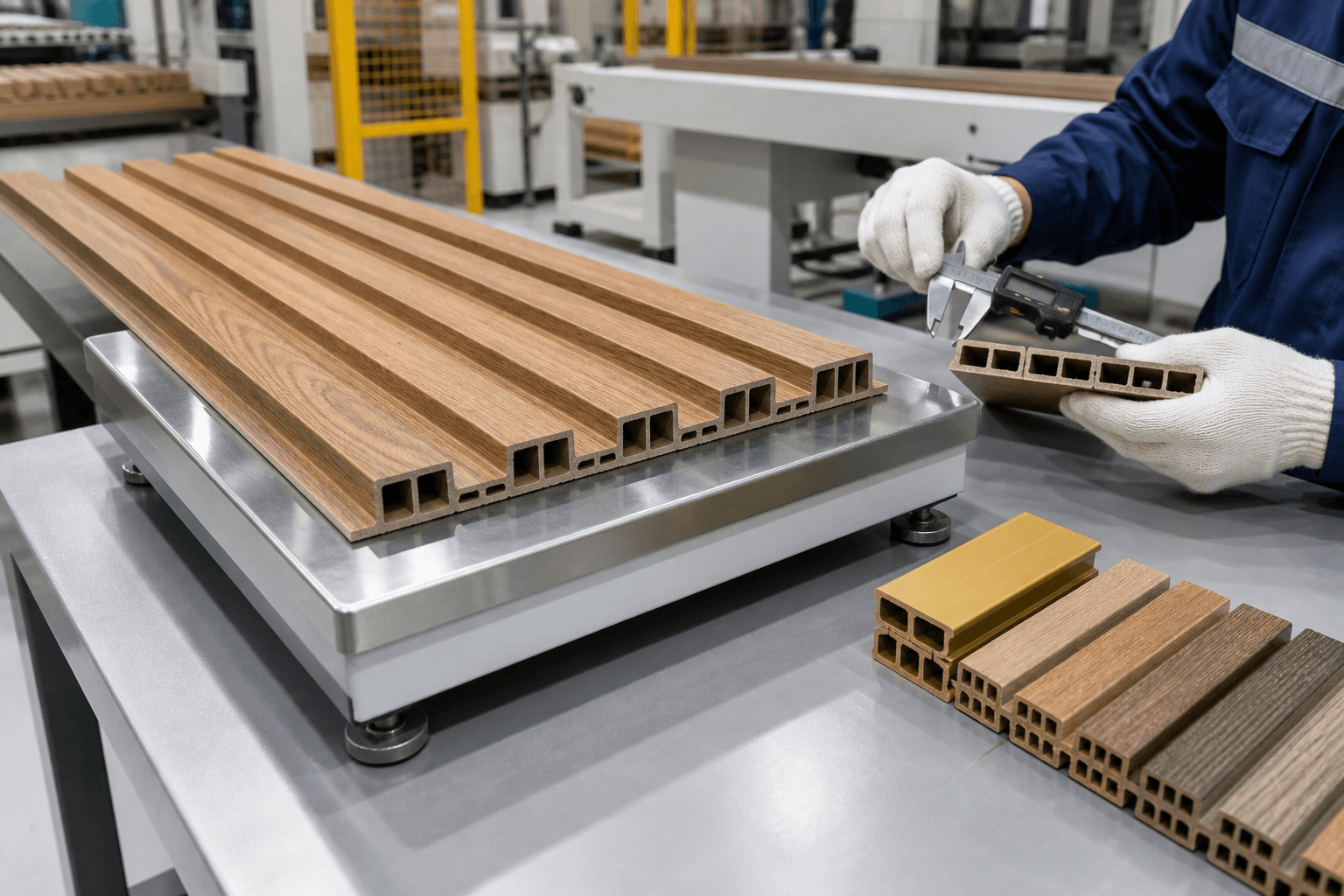
PVC wall panel density hollow structure checks should treat material density, profile shape, and finished weight as separate facts. A heavy panel is not always stronger, while a hollow panel is not always weak. Buyers need a drawing and a clear measurement basis before comparing offers.
For example, two boards can share the same outside thickness but have very different inner webs. Their mass, fixing edges, and response to contact may also differ. So, compare the actual section rather than ranking products by one unexplained number.
This guide helps importers turn density and section data into useful buying checks. For the wider sourcing process, start with our PVC wall panel manufacturer guide.
PVC wall panel density hollow structure: three separate checks
First, identify what the seller means by density. It may describe the solid compound or a value based on the whole outside profile. Those figures use different volume definitions, so explain the basis before comparing them.
Distinguish compound density from the whole profile
Density means mass divided by a defined volume. For a hollow profile, the outside volume includes air spaces that contain no solid compound. So, record whether the quoted value includes those spaces or measures only the material.
ASTM D792 covers density and relative density of solid plastics by displacement. Ask the testing party how its specimen and method relate to your supplied profile. Do not assume an unexplained catalog density comes from that method.
Also, keep foamed and hollow builds distinct. Small cells within a foamed core differ from large channels formed by a profile die. A photo of one cut edge can help identify the build, but it does not prove performance.
Add mass per length and mass per covered area
Ask for the mass of a measured panel length and its usable width. Then, calculate mass per covered area using the actual coverage. This helps your team plan handling and compare repeated shipments on the same basis.
For interlocking profiles, overall width may exceed usable coverage. If you use the larger width, the calculated mass per covered area will look lower. So, agree which width belongs in the calculation before comparing products.
For a worked example, suppose a sample weighs two kilograms. Its length is two meters, so its mass per meter is one kilogram. This is a math example, not a quoted product value.
If usable width is one meter, the covered area is two square meters. The mass per covered square meter is then one kilogram. That result describes weight over the face area, not the density of the solid core.
To find the core density, the test needs the right mass and solid volume. Do not use the outside depth as though the air spaces were solid. Keep the units beside each value so the buyer can check the math.
Our WPC and PVC wall panel comparison helps keep the material families separate. The same measurement habits can support both choices. However, each product still needs its own section drawing and use instructions.
Read the face, back, webs, and joining edges
Overall panel thickness describes the outer depth, not the thickness of every wall within it. A hollow profile contains a face, back, webs, and joining edges. Each part has a role that a single outside dimension cannot explain.
Mark the important dimensions on a section drawing
Request a readable cross section with dimensions at the face, back, webs, and fixing edge. Also, mark the usable width and joint engagement. The drawing should identify the exact profile code that appears on the quote.
For example, a fixing edge may need enough material to support the approved fastening detail. The center of a broad face may have another thickness. Measure the marked points rather than taking one reading from an easy corner.
The decorative PVC marble sheet is a broad sheet product to consider separately. Do not assign a hollow profile’s inner web dimensions to that sheet. Its own build and thickness need their own order record.
Check the joint with two real pieces
Fit two sample pieces together and review the front seam, engagement, and alignment. Then, compare the joined sample with the drawing. A loose edge can feel different once it forms a complete connection.
Also, check whether the planned cut leaves a usable fixing edge. An end piece beside a door may need a trim or another support detail. Resolve that issue on the layout before the team orders full lengths.
When reviewing sections with ZHONGXINGWO, connect the sample, drawing, and quote through one product code. Ask which build applies to the specific order. A general wall panel description cannot settle these small but important details.
Compare like products without making unsupported quality claims
Density can help describe a product, but it cannot rank every PVC panel from good to bad. Geometry, material build, finish, backing, and fixing method all affect use. So, compare products within a defined use and agreed test scope.
Keep weight and performance in different columns
A lower mass may help the crew move a panel through a busy site. However, it does not establish impact resistance or a permitted fixing span. A higher mass also does not establish fire behavior or long service life.
Ask which product checks support the planned wall location. For example, a service corridor may need evidence about the planned impact conditions. The result should describe the actual product and assembly rather than a similar looking sample.
| Buying field | Record this basis | Avoid this shortcut |
|---|---|---|
| Compound density | Specimen, method, and unit. | Treating every density value as equivalent. |
| Overall thickness | Outside section depth and limits. | Assuming it equals face thickness. |
| Face and webs | Marked measurement locations. | Measuring only one convenient edge. |
| Usable coverage | Width after joint engagement. | Using overall width for every calculation. |
| Finished mass | Length, width, and included layers. | Calling a heavier board stronger. |
Match the finish and use conditions
A surface film or coating changes the finished build, even when the profile shape stays the same. Keep its code in the sample record. If the finish changes, review the evidence that depends on it.
Our OEM PVC wall panel customization guide explains how to connect color and film choices with order codes. Use that record beside the section drawing. This prevents a repeat order from silently changing both the face and core.
Also, separate indoor decorative use from direct wet exposure or outdoor use. A cell structure by itself cannot approve those uses. Follow the right product instructions and project review for the chosen wall system.
Build a repeatable sample and batch check
The most useful density record supports a check that another person can repeat. Agree the sample location, tools, units, and condition before the check. Then, keep the same method when checking production and later deliveries.
Measure without changing the basis halfway through
First, confirm whether protective film remains on the sample during the check. State whether the mass includes it and any backing layers. Then, use that basis consistently across the sample and shipment records.
Mark the thickness measurement points on a photograph or section sketch. Also, record the panel length and usable width for weight calculations. A result without those details can be difficult to compare with the next batch.
If a reading looks unusual, check the method before rejecting the material. A wrong width basis or a different finish may explain the difference. However, do not dismiss a true mismatch without checking the approved order limits.
Agree limits and the response to a mismatch
Set accepted dimensional and mass ranges with the seller before checks begin. Those limits should match the product and project needs. Avoid adopting a generic range from another material or profile.
If a sample falls outside the agreed range, isolate the affected batch for review. Check whether the issue concerns dimensions, material build, or the measurement method. Then, record the agreed sorting, replacement, or further testing action.
Keep appearance checks beside the measurements, since a correct mass does not prove an acceptable finish. Look for damaged edges, uneven joints, and visible surface marks. The inspector should use the same approved sample that the buyer retained.
Use section data for packing, fitting, and repeat orders
Good technical records help beyond the first purchase decision. The installer needs to know how the profile joins and where fixing details apply. The freight team needs actual pack dimensions and weights rather than an unsupported density estimate.
Carry the approved drawing through the supply chain
Put the product code and drawing revision on the purchase order and pack labels. Then, link each shipment to the right batch record. This helps the receiving team match stock without guessing from the surface color.
Check the packing plan for support across long profiles and protection at joining edges. A board can meet the factory measurement checks and still suffer damage in transit. So, inspect typical packed material before release where the order needs it.
For mixed orders, keep broad sheets and hollow profiles easy to distinguish. Their handling and stacking instructions may differ. A clear packing list should show the actual product rather than one combined wall panel line.
Keep later substitutions visible
- Retain the approved section drawing and sample code.
- Record the mass and dimensions using the agreed basis.
- Check any changed core, finish, or profile before repeat supply.
- Keep received pack labels with the batch check record.
- Review damage or fitting issues before placing the next order.
Finally, use density as one descriptive value within a complete product file. The section, finish, fixing details, and suitable evidence matter alongside it. That approach gives buyers a clearer comparison than a single high or low number.
Need help checking PVC wall panel density and hollow sections? Send us an inquiry with your profile drawing and planned use. Our specialists will reply and help you review the product details.
