

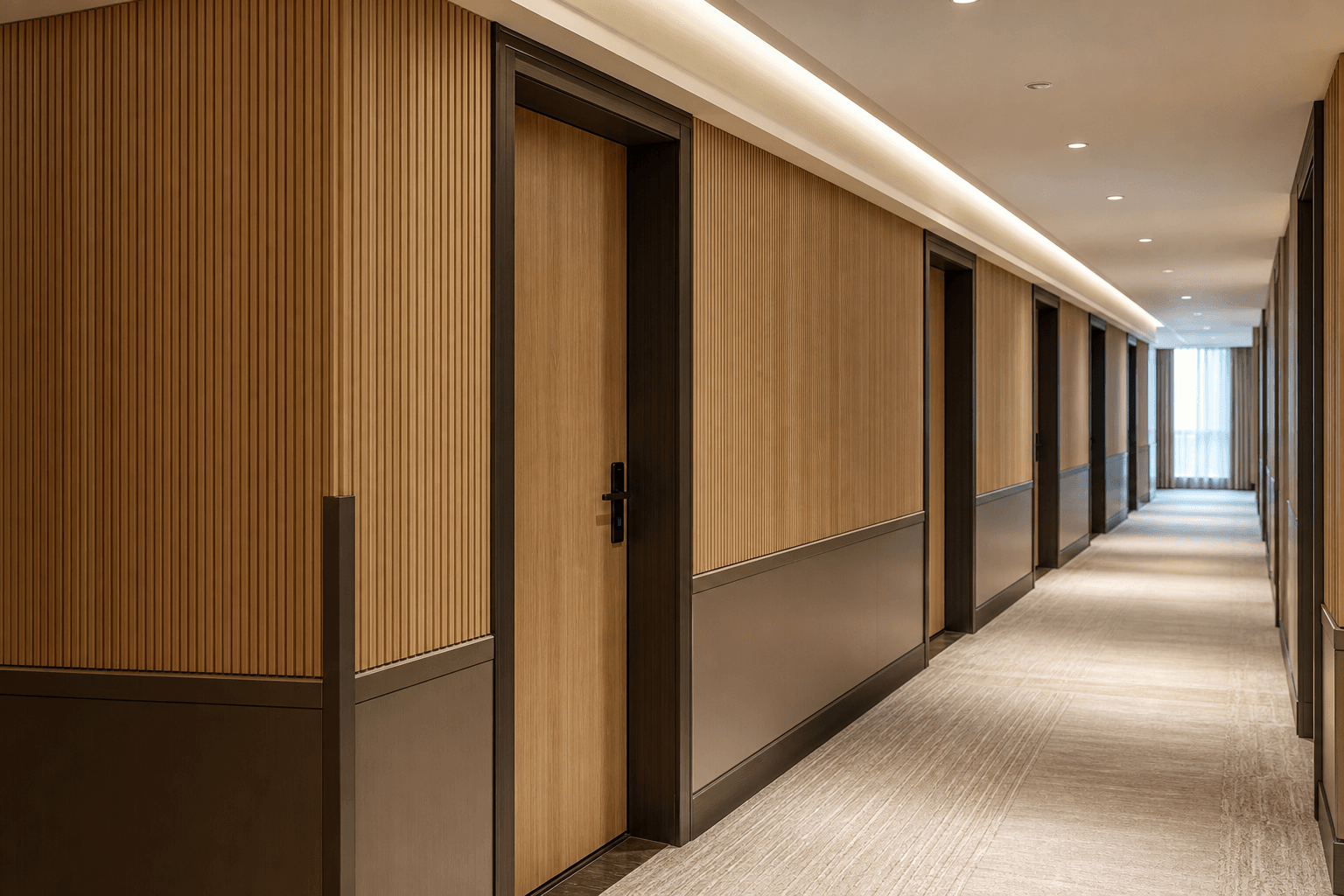
A scratch resistant indoor WPC wall panel needs evidence matching its surface construction and expected contact conditions. The description does not mean the panel cannot be marked or damaged. Buyers should review scratch, abrasion, and impact performance as separate questions.
For commercial passageways, the complete wall detail also matters. Corners, low wall zones, door interfaces, and cleaning routines can expose weaknesses beyond the central panel face. Define those conditions before selecting a finish or requesting bulk prices.
This guide explains how purchasing teams can compare relevant evidence and plan a practical mockup. It does not assign an untested scratch rating to any supplier’s product.
Define the Contact Conditions in Your Passageway
High traffic describes activity, but it does not identify the source of damage. A hotel corridor receives different contact from a retail stock route. Record the objects and operations likely to reach the wall.
Consider luggage, trolleys, cleaning equipment, door hardware, and temporary displays. Identify their typical routes and contact locations. Avoid assuming that a busy area automatically needs the same panel specification as another busy building.
Separate Different Types of Surface Damage
A scratch can involve concentrated contact moving across a surface. Abrasion concerns wear under another defined contact process. Impact introduces a separate loading event that may damage the panel or its connections.
Evidence for one mechanism should not automatically become a claim about the others. Ask suppliers to identify the property being reported. Keep the terminology consistent across quotations, technical reviews, and distributor descriptions.
Use the wholesale WPC wall panel supplier guide to connect these requirements with the broader order specification. Include the actual location and installation arrangement. An evidence request is more useful when the intended application is clear.
Map Vulnerable Interfaces
Lower wall zones and projecting corners may receive concentrated contact. Doorways can create repeated damage patterns that differ from open corridors. Mark these areas on the drawings sent for review.
Consider separate protection or revised details where the project team identifies a need. A more resistant central board cannot automatically protect every junction. Coordinate the solution with the designer rather than relying on the surface label alone.
The selected profile also changes where contact occurs. A raised face may meet objects differently from a recessed section. Include the actual geometry in the review instead of comparing only flat finish samples.
Request Scratch Evidence for the Actual Finish
Ask how the proposed panel’s scratch resistance was evaluated. Request the specimen description, test method, conditions, and assessment criteria. Confirm that the tested construction matches the profile and finish being quoted.
A supplier may offer several coatings, laminates, or surface constructions under similar product names. A result for one should not automatically cover the others. Obtain a documented explanation where a report uses a different identification code.
Read the Method and Result Together
The ASTM instrumented scratch test method addresses evaluation of polymeric coatings and plastics. Its suitability needs review for the particular product and purpose. A method reference alone does not establish a universal commercial corridor rating.
Ask about the contact tool, applied conditions, specimen preparation, and criteria used to identify damage. Retain the units and terminology from the report. Do not compare unexplained numbers from different methods as though they represent the same result.
Also ask whether the evaluation concerns visible marking, coating damage, or another defined endpoint. These outcomes can matter differently to the project. The responsible reviewer should identify the evidence needed for acceptance.
Keep Abrasion Evidence Separate
The ASTM coating abrasion test method concerns an identified abrasive testing procedure. It should not be treated as a direct replacement for scratch evaluation. Confirm what the result actually supports.
When comparing abrasion reports, review the specimen, equipment settings, and reported endpoint. Different conditions can produce values that cannot be ranked directly. Request clarification before adding a result to a comparison table.
Neither test automatically describes resistance to trolley impacts or fixture loads. Keep those questions in separate rows of the technical review. A stronger claim requires evidence relevant to that claim.
| Requirement | Evidence to request | Assumption to avoid |
|---|---|---|
| Scratch behavior | Method, specimen, conditions, and endpoint | Every visible mark is prevented |
| Abrasion behavior | Matching wear test and result basis | Wear and scratching are identical |
| Impact behavior | Relevant profile and support evaluation | A hard face prevents panel damage |
| Cleaning compatibility | Approved method for the exact finish | Any chemical is acceptable |
| Installed appearance | Representative mockup and acceptance reference | A small sample shows every joint |
Compare Appearance and Cleaning in a Representative Mockup
A commercial passageway wall panel must satisfy appearance expectations as well as documented performance requirements. Review the actual finish under the intended lighting. Include adjoining pieces and important edges rather than approving a central sample alone.
Some marks may be more visible under particular lighting or viewing conditions. Do not assume a photograph predicts that appearance reliably. Agree the review conditions and record the accepted reference.
Include the Selected Profile Geometry
For relief profiles, review raised faces, recesses, and transitions between panels. The Great Wall interior sourcing guide explains the importance of adjoining pieces and interface planning. Use that process when the decorative pattern affects contact or cleaning.
Place representative trims and adjacent materials in the mockup. Check where a trolley, door, or cleaning tool could meet an exposed edge. Ask the project team whether that junction needs a revised detail.
Keep mockup observations separate from standardized test evidence. A demonstration can help assess practical appearance and workmanship. It does not establish an engineering classification or replace required laboratory evaluation.
Review the Proposed Cleaning Routine
Request cleaning instructions for the exact surface. Identify approved tools, chemicals, and any stated restrictions. Do not transfer instructions from an unrelated composite material merely because both products cover walls.
Test unfamiliar cleaning methods on an agreed sample or inconspicuous area before wider use. Record the method and result. Avoid escalating to stronger chemicals or abrasives without product-specific guidance.
The WPC maintenance and lifespan guide explains how to retain care and inspection records. Cleaning compatibility belongs in the original purchasing review. It should not first become a discussion after a wall has been marked.
Define What Appearance Approval Means
Agree the approved finish range, viewing conditions, and relevant acceptance references. Keep signed samples available to the supplier and receiving team. A generic color name does not establish the complete visual standard.
If a later finish change is proposed, review both appearance and relevant performance evidence. A similar visible color may use a different surface construction. Do not let a cosmetic approval authorize an undocumented material substitution.
Coordinate Installation and Replacement Before Bulk Ordering
The board is one component of the installed passageway wall. Supports, fixings, trims, and accessories also require coordination. Request current installation information and have the responsible project reviewer assess the proposed arrangement.
Check the substrate and intended attachment method before comparing board-only offers. A low panel price may exclude components needed for the application. Ask each bidder to identify included and excluded items clearly.
Resolve Corners, Doors, and Fixtures
Door handles and adjacent hardware can create predictable contact locations. Review these on the actual layout. Coordinate stops, trims, or other relevant details through the project design process.
Fixtures should connect to suitable backing through an approved arrangement. Decorative panels should not be assumed to support equipment independently. Identify penetrations and access points before the cutting schedule is finalized.
Ask how joints and trims are treated where the wall changes direction. Confirm their material and finish references. An attractive face with unresolved edges is not a complete commercial interior package.
Plan Localized Replacement
Ask how an individual damaged section can be removed and replaced. Identify whether adjacent panels or trims must also be disturbed. Restricted access can affect maintenance costs and disruption.
Discuss spare quantities as part of the project plan without inventing a universal percentage. Label retained material with the product, finish, and batch references. Follow the supplier’s storage guidance for that construction.
A replacement from a later batch may differ from the installed material. Review samples under relevant lighting before approval. Keep expectations about matching realistic and documented.
Retain a Useful Handover Record
Combine drawings, product references, approved samples, cleaning instructions, and inspection records. Assign responsibility for retaining them after installation. Maintenance teams need to identify the actual construction rather than search through an old sales catalog.
Record recurring damage locations and any approved corrective details. Repeated replacement may leave an underlying contact problem unresolved. Coordinate investigations with the relevant designer, operator, installer, and supplier.
Prepare an Evidence-Based Purchase Inquiry
Shortlist candidates from the WPC wall panel category. Ask for current documents supporting the intended interior application. Treat scratch resistance as a property to verify for each proposed finish.
Send ZHONGXINGWO the passageway layout and expected contact conditions. Include finish preferences, quantities, and cleaning requirements. Request clearly identified samples and a quotation matching those references.
- Describe contact sources instead of relying on a high-traffic label.
- Separate scratch, abrasion, and impact evidence.
- Match test results to the proposed surface construction.
- Review cleaning and vulnerable junctions in a representative mockup.
- Confirm replacement access and retained product identification.
The practical objective is a suitable, maintainable wall with supportable performance claims. That requires more than an anti-scratch label. Clear application details and matching evidence give buyers a stronger basis for comparing commercial offers.
Join our official LINE account to ask your questions. Our specialist will contact you right away.
